
Solutions
Mathematics
Building Curious, Confident Mathematical Thinkers

From Concept to Classroom
At Creative Leadership Solutions, we partner with schools and districts to strengthen mathematics teaching and learning through research-based practices that fit any curriculum.
Through collaborative workshops and real-time coaching, teams build the systems, instructional practices, and leadership actions that grow confident, capable mathematical thinkers and ensure equitable access to rigorous math learning.
Outcomes
- Build student and educator confidence, engagement, curiosity, and mathematical identity.
- Deepen mathematical reasoning, conceptual understanding, and fluency.
- Promote coherence and consistency of mathematics instruction across classrooms, grade levels, and schools
- Strengthen systems for assessment, intervention, and instructional decision making.
Six Core Areas of Practice
- Leading Mathematics Improvement
- Cultivate Mathematical Confidence
- Strengthen Teacher Content Knowledge
- Advance Learning Through Assessment
- Build Curious Mathematical Thinkers
- Strengthen Retention and Fluency

Frequently Asked Questions
-
What makes your mathematics support different?
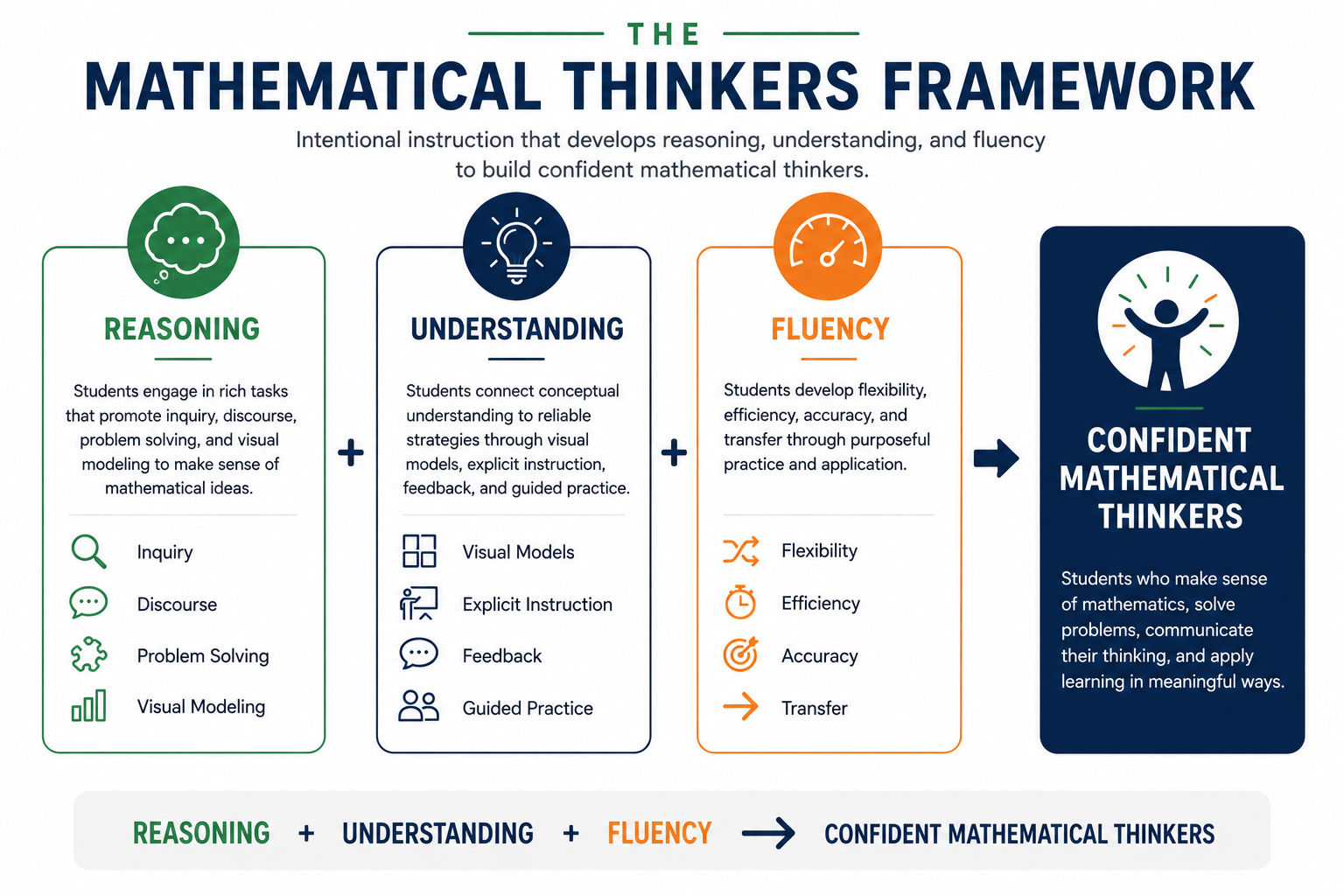
Our approach is grounded in the belief that effective mathematics instruction intentionally develops reasoning, understanding, and fluency. Rather than promoting a specific program, we help educators strengthen instructional practices, assessment systems, and leadership actions that support curious, confident mathematical thinkers. -
Do you work with a specific mathematics curriculum?
No. Our work is curriculum-agnostic and can be implemented within any mathematics program or resource. We focus on research-based practices that strengthen teaching and learning regardless of the curriculum being used. -
Is this focused on conceptual understanding or fluency?
We believe both are essential. Our Mathematical Thinkers Framework emphasizes the intentional development of reasoning, understanding, and fluency. Students need opportunities to make sense of mathematics, connect concepts to reliable strategies, and develop flexibility, efficiency, and accuracy through purposeful practice and application. -
What does implementation look like?
We partner with schools and districts to create lasting impact through professional learning, coaching, and implementation support tailored to their goals and needs. Workshops and conference sessions are available as focused learning opportunities and potential entry points into deeper implementation work. -
Is this only for elementary mathematics?
No. Support can be customized for elementary, secondary, intervention, instructional coaches, site leadership teams, and district leadership teams. -
How do you support student confidence in mathematics?
We help educators create classrooms where curiosity, persistence, risk-taking, and productive struggle are valued. Through strong instructional practices and supportive learning environments, students develop confidence in their ability to reason, solve problems, and communicate mathematical thinking.
Focus on what matters. Let us help you grow.
Our experts have decades of experience in K-12 education and administration and are dedicated to delivering personalized and differentiated learning opportunities to help your team grow.