
By Gregory VanHorn
Introduction: Why Look Outside Education?
Educators are understandably cautious when lessons are drawn from outside K–12 schooling. Industry comparisons too often reduce education to efficiency, compliance, or factory-style thinking. This article makes no such claim. Instead, it begins from a different premise: schools and high-reliability organizations face the same fundamental challenge—how to help people do complex, human-centered work well, together, under conditions of variability. This article advances one central claim:
High-reliability operating models succeed for the same reasons effective schools do—through disciplined collaboration, clarity of standards, rapid feedback, and tiered response when performance varies.
In recent years, GE Aerospace has articulated and scaled an operating model known as FLIGHT DECK. Rather than a program or initiative, FLIGHT DECK functions as a cultural and operational framework designed to reduce variability, surface problems early, and ensure teams respond coherently when performance diverges from expectations. Its emphasis on disciplined collaboration, clarity of standards, rapid feedback, and structured response mirrors—perhaps unintentionally—the foundational principles of effective Professional Learning Communities (PLCs).
Public statements by H. Lawrence Culp Jr., CEO of GE Aerospace, emphasize that FLIGHT DECK is not about accelerating work through pressure. It is about creating the conditions under which people can execute reliably and improve continuously. Respect for people, psychological safety, and clarity of roles are treated as operating necessities—not aspirational values.
The purpose of this article is not to import aerospace practices wholesale into schools, nor to suggest that education should mimic industrial systems. Rather, it seeks to translate how a high-reliability operating model addresses common organizational challenges— initiative overload, inconsistent follow-through, and uneven responses to performance data—and to examine how those same challenges persist in PLC implementation across K–12 settings.
When PLCs struggle, it is rarely because educators lack commitment or expertise. More often, the issue is cultural and structural: expectations are implicit rather than explicit; data is reviewed without triggering action; and responsibility diffuses rather than being shared intentionally. By examining PLCs as Tier 1 instructional engines—and MTSS as a structured response system—educators and educational consultants can strengthen coherence without sacrificing professional autonomy or trust.
The central challenge facing PLCs and MTSS is not belief, effort, or expertise—but operating-model design.
This article will: 1. Reframe PLCs as operating models rather than meetings, 2. Clarify the relationship between PLCs and MTSS as one coherent system, and 3. Argue that disciplined follow-through becomes routine only when it is embedded by design.
Seeing PLCs as an Operating Model
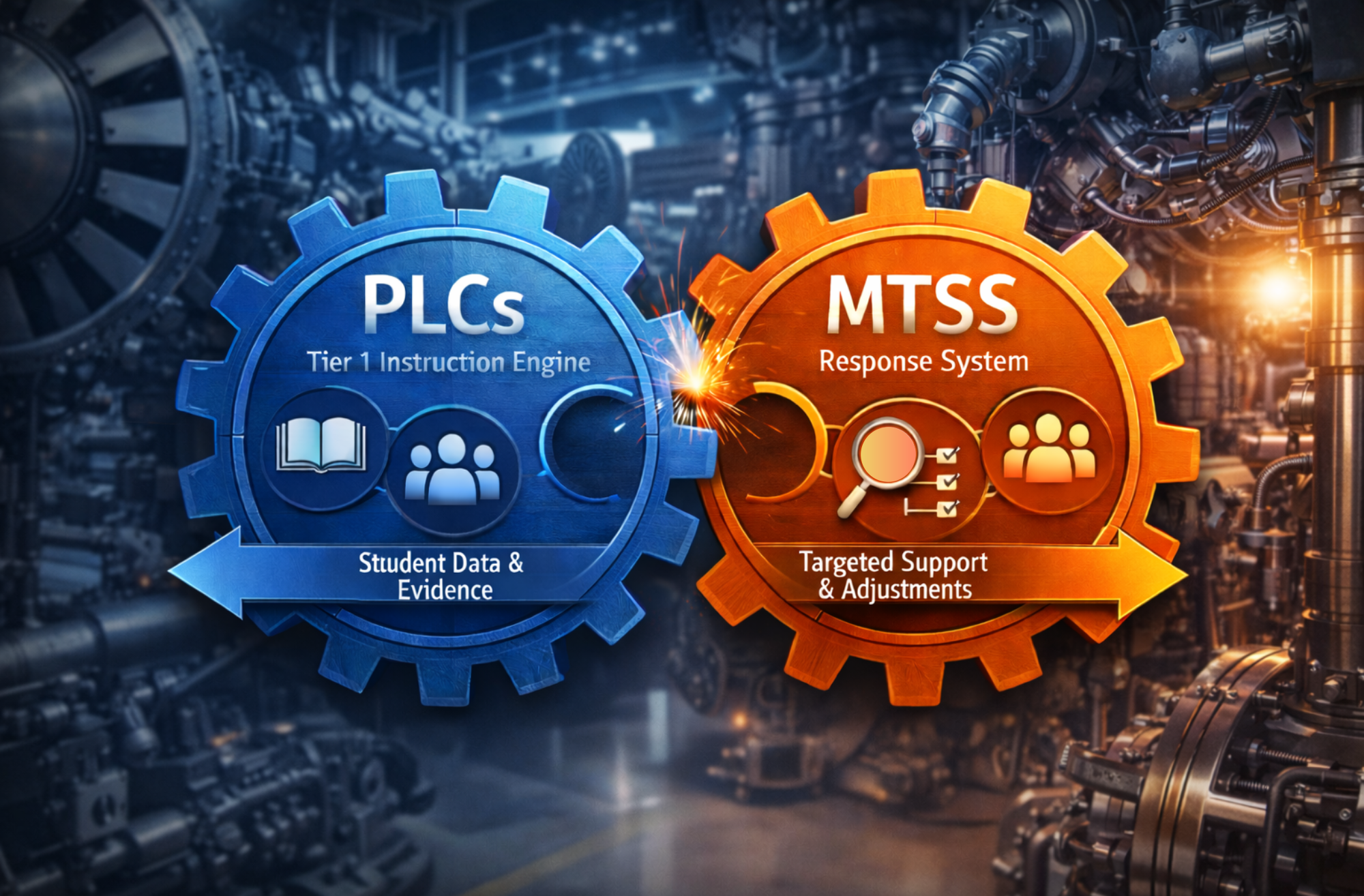
PLCs as Tier 1 Instructional Engines; MTSS as the Response System
Educational research has long supported the idea that collaborative inquiry improves instructional practice when it is purposeful, evidence-based, and results-oriented. Richard DuFour (2010) described PLCs as cultures in which educators are collectively committed to learning, collaboration, and results. Central to this model are four guiding questions:
- What do we want students to learn?
- How will we know if they learned it?
- What will we do when they do not learn it?
- What will we do when they already have?
In practice, many districts implement PLCs structurally—scheduled meetings, shared assessments, posted norms—without fully operationalizing these questions. At the same time, MTSS frameworks are often introduced as parallel systems, unintentionally creating duplication, confusion, and competing expectations.
A more coherent design clarifies roles:
- PLCs function as the Tier 1 instructional engine, responsible for the quality and consistency of core instruction.
- MTSS functions as the response system, activating when strong Tier 1 instruction still produces variable outcomes.
This distinction matters. PLCs generate evidence about instructional effectiveness. MTSS responds when that evidence shows persistent variability. When these roles blur, neither system functions reliably. PLCs become reflective but inconsequential, and MTSS becomes a workaround rather than a response.
A Cultural Crosswalk Between Industry and Education
Where Reliability Is Built
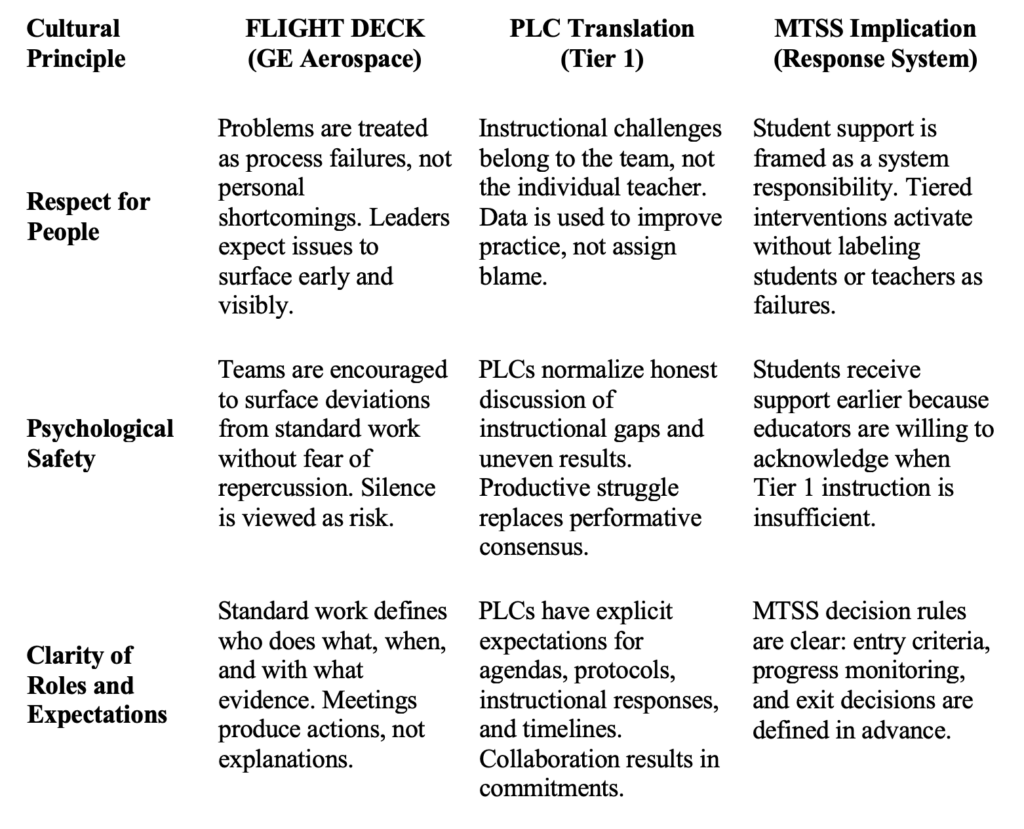
The most productive parallels between FLIGHT DECK and PLCs do not reside in tools or terminology. They reside in culture. Research and practice converge on three cultural conditions that determine whether collaborative systems succeed.
Respect for People
In high-reliability organizations, problems are treated as system issues rather than personal failures. Leaders expect issues to surface early and visibly. Similarly, effective PLCs treat instructional challenges as collective responsibilities. Data is used to improve practice—not to assign blame.
This orientation allows problems to surface before they become entrenched. It shifts the question from Who is struggling? to What in our system is producing this result?
Psychological Safety
In high-reliability settings, silence is treated as risk. Teams are expected to surface deviations from expectations quickly and honestly. In PLCs, psychological safety allows educators to discuss uneven results without fear of judgment.
Without this safety, collaboration becomes performative rather than productive. Teams comply with protocols but avoid the conversations that would actually improve instruction.
Clarity of Roles and Expectations
FLIGHT DECK relies on standard work to define who does what, when, and with what evidence. In education, standard work does not mean scripted teaching. It means clarity about PLC purposes, products, and follow-through expectations.
When expectations are explicit, professional autonomy is protected rather than diminished. Ambiguity—not clarity—is what erodes trust.
From Operating Model to Instructional Practice
Culture and structure do not operate as separate forces in organizations; they are mutually reinforcing. Culture shapes how people interpret expectations—what feels normal, worthwhile, or worth pushing through. Structure determines whether those beliefs are consistently translated into action.
When structures such as meeting routines, decision rules, and feedback cycles align with stated values, they make the culture tangible and unavoidable. Culture without structure becomes aspirational talk. Structure without culture becomes compliance theater.
Together, culture provides the why and structure provides the how.
What Happens When Collaboration Becomes Comfortable—Yet Improvement Stalls?
In many schools, PLCs are structurally sound but operationally weak. Teams meet regularly. Agendas are prepared. Norms are posted. Data is reviewed. From the outside, collaboration appears healthy.
From the inside, however, PLCs often function as events rather than as systems that reliably produce instructional change.
A typical PLC meeting follows a familiar pattern. Teams examine common assessment results, identify trends, and discuss possible explanations for uneven performance. The conversation is professional and collegial. Time runs out. The meeting ends.
Teachers return to their classrooms with greater awareness—but without a shared, collective commitment to change instructional practice in a specific way.
Nothing about this pattern reflects negligence or lack of professionalism. In fact, it aligns with many values schools rightly hold: respect for teacher autonomy, thoughtful reflection, and collegial dialogue.
Over time, however, this design produces a predictable outcome.
Collaboration becomes comfortable, but its impact becomes optional.
Discussion substitutes for decision-making. Explanation replaces response. Instructional adjustments become individual choices rather than collective commitments. Followthrough depends on personal motivation rather than system expectation.
MTSS often reinforces this pattern. When Tier 1 instruction produces inconsistent results, systems frequently respond by moving students into additional supports rather than revisiting shared instructional practice. MTSS absorbs variability instead of triggering improvement in Tier 1.
This pattern persists even in schools with strong professional cultures and deep commitment. The issue is not belief in PLCs or resistance to data.
It is that nothing in the operating design requires teams to move from analysis to action.
Disciplined Follow-Through Is a Design Problem
If PLCs are meant to function as engines of instructional improvement, they must do more than convene professionals. They must make response to evidence predictable, collective, and unavoidable.
Disciplined follow-through is uncomfortable. It requires teams to confront uneven results, adjust shared practice, and make instructional decisions visible. In loosely designed systems, this discomfort creates an escape hatch.
Teams can explain rather than respond. They can defer rather than commit. They can shift responsibility elsewhere.
Avoidance is often mistaken for psychological safety. In reality, psychological safety is not the absence of discomfort, but the presence of clarity and support when discomfort arises.
When systems rely on individuals to summon courage without structural support, avoidance becomes embedded. This is not a moral failure. It is a predictable outcome of ambiguous design.
Well-designed systems remove this burden from individuals. Expectations are explicit. Triggers are defined. Follow-through is normalized.
Discipline becomes routine rather than heroic.
An Operating Model, Not an Initiative
FLIGHT DECK is not a set of tools layered onto existing work. It is an operating model that governs how work flows through the organization. Its purpose is not to add effort, but to remove ambiguity.
High-reliability systems assume variability is inevitable. Conditions change. Human judgment varies. Rather than attempting to eliminate variability, these systems focus on how quickly and coherently the organization responds when variability appears.
This orientation has direct relevance for education. Schools are inherently variable environments, yet many improvement efforts assume consistency will emerge through better planning or increased compliance.
Reliability, however, is achieved not by preventing variation—but by designing clear, predictable responses to it.
Reframing PLCs and MTSS as One Coherent System
A coherent improvement model begins with a clear distinction:
- PLCs function as the Tier 1 instructional engine.
- MTSS functions as the response when Tier 1 instruction does not produce consistent results.
When this distinction is explicit, improvement efforts align. When it is not, PLCs and MTSS drift into parallel structures with competing purposes.
In many schools, PLCs are positioned as reflective spaces while MTSS is positioned as the place where action occurs. This design unintentionally signals that Tier 1 instruction is not expected to change in response to evidence. MTSS becomes a workaround rather than a response.
In coherent systems, PLCs and MTSS are interdependent. PLCs generate evidence. MTSS activates when that evidence shows Tier 1 is insufficient. MTSS does not replace PLC work—it extends it.
What Disciplined Follow-Through Actually Looks Like
In systems designed for follow-through, clarity replaces ambiguity. Expectations are known before meetings begin. Evidence triggers action automatically. Instructional response is collective rather than optional.
Teams agree in advance on what success looks like—and what happens when results fall short. Collective instructional adjustments are made, monitored, and revisited. Leadership protects the process and resists initiative overload.
Discipline, in this context, is not control. It is protection—from ambiguity, from drift, and from the quiet erosion of purpose that occurs when collaboration does not lead to change.
What Education Should Not Import from Industry
Translation requires boundaries. Without guardrails, attempts to strengthen PLCs can drift toward compliance or rigidity.
- Standard work must not become scripted teaching.
- Metrics must remain signals, not verdicts.
- Efficiency must not be confused with speed.
- Accountability must remain cultural rather than punitive.
Leadership research reinforces this distinction. Effective leaders shape conditions— clarity, focus, and support—rather than relying on control. When accountability is experienced as shared responsibility, improvement becomes sustainable.
Conclusion: From Comfortable Collaboration to Reliable Improvement
PLCs were never intended to be meetings that occur on a calendar. They were designed to be engines for instructional improvement. MTSS was never intended to compensate indefinitely for inconsistent instruction. It was designed to respond when strong Tier 1 practice is not enough.
High-reliability organizations remind us that improvement does not emerge from belief alone. It emerges from systems that remove ambiguity about what happens when results vary.
When PLCs and MTSS are designed to function together—when follow-through is embedded rather than optional—collaboration moves beyond comfort and improvement becomes more predictable.
Reliable improvement is not a matter of will. It is a matter of design.
The work ahead is not recommitment.
It is redesign.
References
Culp, H. L., Jr. (2026). Letter to shareholders. In GE Aerospace 2025 annual report. GE Aerospace.
DuFour, R., DuFour, R., Eaker, R., & Many, T. (2010). Learning by doing: A handbook for professional learning communities at work (2nd ed.). Solution Tree Press.
Hattie, J. (2015). What works best in education: The politics of collaborative expertise. Pearson.
Reeves, D. B. (2010). Transforming professional learning communities into results. Solution Tree Press.
Waters, J. T., Marzano, R. J., & McNulty, B. (2003). Balanced leadership: What 30 years of research tells us about the effect of leadership on student achievement. Mid-continent Research for Education and Learning.